


Historic buildings represent more than just a reminder of the past. They depict a city’s spirit and personality through finely crafted designs based on the ingenuity of their time. The cultural weight that a historic building holds in a city requires a sensitive but forward-thinking approach to its maintenance.
Custom mechanical, electrical and plumbing (MEP) solutions for historic building renovations should preserve the beauty of the original design and leverage modern innovations to reinforce it. It’s less about changing the character of a historic building and more a matter of respecting it by integrating thoughtful MEP systems that enhance efficiency and energy.
This presents a range of challenges for MEP services in historic buildings, which will test the ability to upgrade the architecture without affecting the structure’s original beauty. Explore common challenges and potential solutions to ensure that historic buildings remain intact and up to date with modern MEP systems.
Economic and population growth have led experts to project an estimated 30% global increase in construction energy demand by 2035. Several industries and institutions are looking to reuse existing buildings in lieu of demolishing them for the sake of a new build.
However, implementing innovative MEP services in historic buildings offers many other significant benefits beyond this, including:
Through MEP engineering, historic buildings can continue to preserve their visual and architectural legacy with the added benefit of new systems within. However, the intricate techniques required to do this effectively present several hurdles.
Here are some of the most significant challenges faced and how our team of highly skilled engineers has resolved them in the past.
The plumbing and overall piping used in historical buildings can be run down and out of step with modern safety requirements. Due to the potential layout and need for comprehensive renovations, conducting a complete upgrade can be a big challenge.
Successfully integrating new plumbing systems requires expertise and careful consideration of the design of existing building conditions, such as our work on the First United Methodist Church in Boston, MA.
We provided mechanical, electrical, plumbing and fire protection design to upgrade the 1870s church’s heating solutions. Through comprehensive surveys of the existing conditions, we assisted in upgrading the building’s heating systems, which included condensate piping and new technologies to monitor energy usage.
Upgrading MEP services in historic buildings can include navigating crucial electrical system work. Many outdated solutions have wiring that is incapable of supporting modern appliances and lighting. Older systems in historical buildings also often have potential fire hazard risks.
Electric systems upgrades for historic buildings can be complex and compliance-heavy. Our complete design services provide everything from code reviews to complete redesigns. Our comprehensive understanding of regulations and electrical code compliance helps to reduce electrical fire hazards.
Historical structures have been designed to predominantly use natural methods of air ventilation and heating. For modern requirements, this presents several challenges to creating a consistent climate.
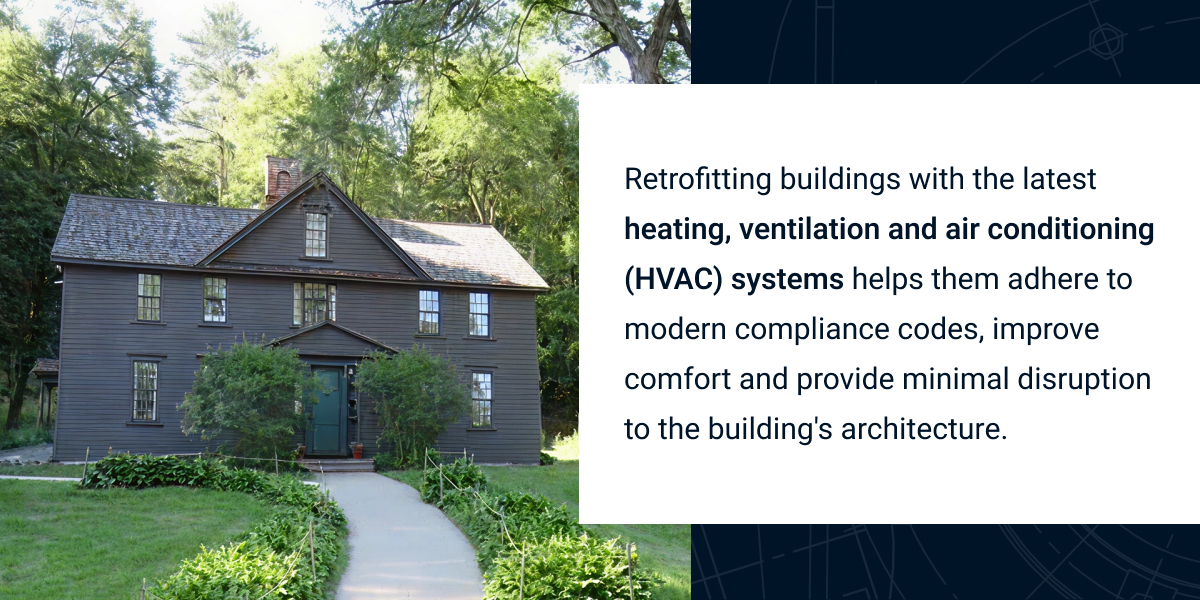
Retrofitting buildings with the latest heating, ventilation and air conditioning (HVAC) systems helps them adhere to modern compliance codes, improve comfort and provide minimal disruption to the building’s architecture.
This requires a deep understanding of mechanical due diligence, like our work on Louisa May Alcott’s Orchard House in Concord, Massachusetts. This historic museum home, built between 1700 and 1710, looks the same now as it did then.
MEP engineering for historic buildings can present challenges in maintaining the building’s character while implementing modern comforts and meeting building codes. Ensuring the successful integration of new systems and adherence to building preservation involves strong communication, attention to detail and an appreciation for historic architecture.
Projects like Loring Parsonage in Sudbury, Massachusetts, built around 1730 and Old Ship Church in Hingham, Massachusetts, built in 1861, demonstrate our commitment to upgrading historic spaces and maintaining their beauty.
The success of a historical building project depends on the diversity of the experts used. You may encounter challenges in preservation standards, environmental goals and external factors like zoning laws and building code specifications. In order to meet these requirements, partnering with experienced professionals is a necessity.
At CSI Engineering, we specialize in delivering tailored MEP solutions that meet modern performance standards while protecting historical value. Our team has over 25 years of experience in delivering historical building services.
MEP systems can be implemented in historic buildings along with the integration of several emerging trends. Here are three of the most vital MEP engineering innovations gaining popularity and enabling historic buildings to remain compliant:
At CSI Engineering, we understand the responsibility that comes with being entrusted with historic development. Overcoming the challenges of effective custom MEP solutions for historic building renovations requires expertise, effort and trust. Our highly skilled staff members have decades of experience and care in integrating MEP systems that maintain aesthetic beauty and structural integrity.
CSI Engineering has provided quality solutions for our clients since 1996. We specialize in custom MEP designs that meet the performance standards of modern needs while protecting the building’s historical value.
Contact us to learn more about our commitment to innovation and sustainability for historic buildings.